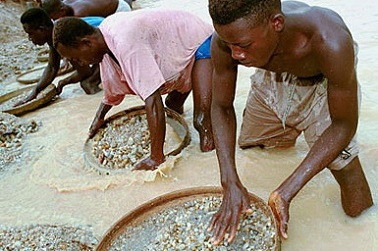
How Diamonds Are Mined
How
are diamonds - small rocks - able to command such high prices? Are diamonds that rare, or does it have to do with how diamonds are mined?
It does have to do with how diamonds are mined because in reality, they
actually aren't as rare as many think.
For example, one stretch of land in Africa alone is estimated to hold far more diamonds
than all of the diamonds on rings today. The trouble is, we can't get to
them.
Why not?
It's because that land is mined, but it isn't the
diamonds that are mined. The land itself is booby trapped with land mines,
enclosed by razor wires and guarded by armed guards.
Why?
That and many other stretches of land with diamond deposits are owned by large
companies that control the world's diamond supply and want to
maintain their high prices and profits by restricting supply.
When you buy diamonds as a consumer, it is pointless to pay for color
ratings below "J" and clarity ratings below "SI2" since lower
ratings are much more expensive but the differences are totally imperceptible to the
human eye and can only be seen under the 10x magnification of a jeweler's gemscope.
Unless you and your friends carry gem scopes around, it's a waste
of money to pay more, let alone much more, for imperceptible differences.
When jewelers hint that you should buy the "
perfect
diamond" that reflects the purity of your love,
they are really reflecting the purity of their greed.
So, if they recommend a VVSI1 D diamond for $20,000, buy a same sized SI2 J
diamond for $5,000 instead. You will save $15,000 and end up with the same-sized diamond that looks just as clear and colorless.
What should you do with the rest of the money?
You said "
heaven is forever," so invest there.
Give it to frontline
missionary groups
that can print and smuggle a Bible into a country where they are banned for $2, and for every Bible brought in,
2 people on average come to believe in
Jesus. $5,000 means 2,500 Bibles
and 5,000 people saved; $15,000 means 7,500 Bibles and 15,000 saved.
Continue